

Strategic Architecture: The Hidden System That Makes—or Breaks—Strategy
#3 in the StrategyReady series

When strategic plans fail, the autopsy is familiar: not enough buy-in, poor execution, too much resistance, or misaligned incentives. But increasingly, these surface-level symptoms are hiding a deeper issue—one that leaders overlook because it’s not visible in the usual dashboards or reports.
That issue is architectural readiness.
Even strong strategies falter when the organisation’s internal systems—its structures, roles, flows, and governance—are still designed for the last strategy. In effect, the strategy has nowhere to go. It runs into an outdated operating system that can’t deliver it.
This is where Strategic Architecture comes in.
What Is Strategic Architecture?
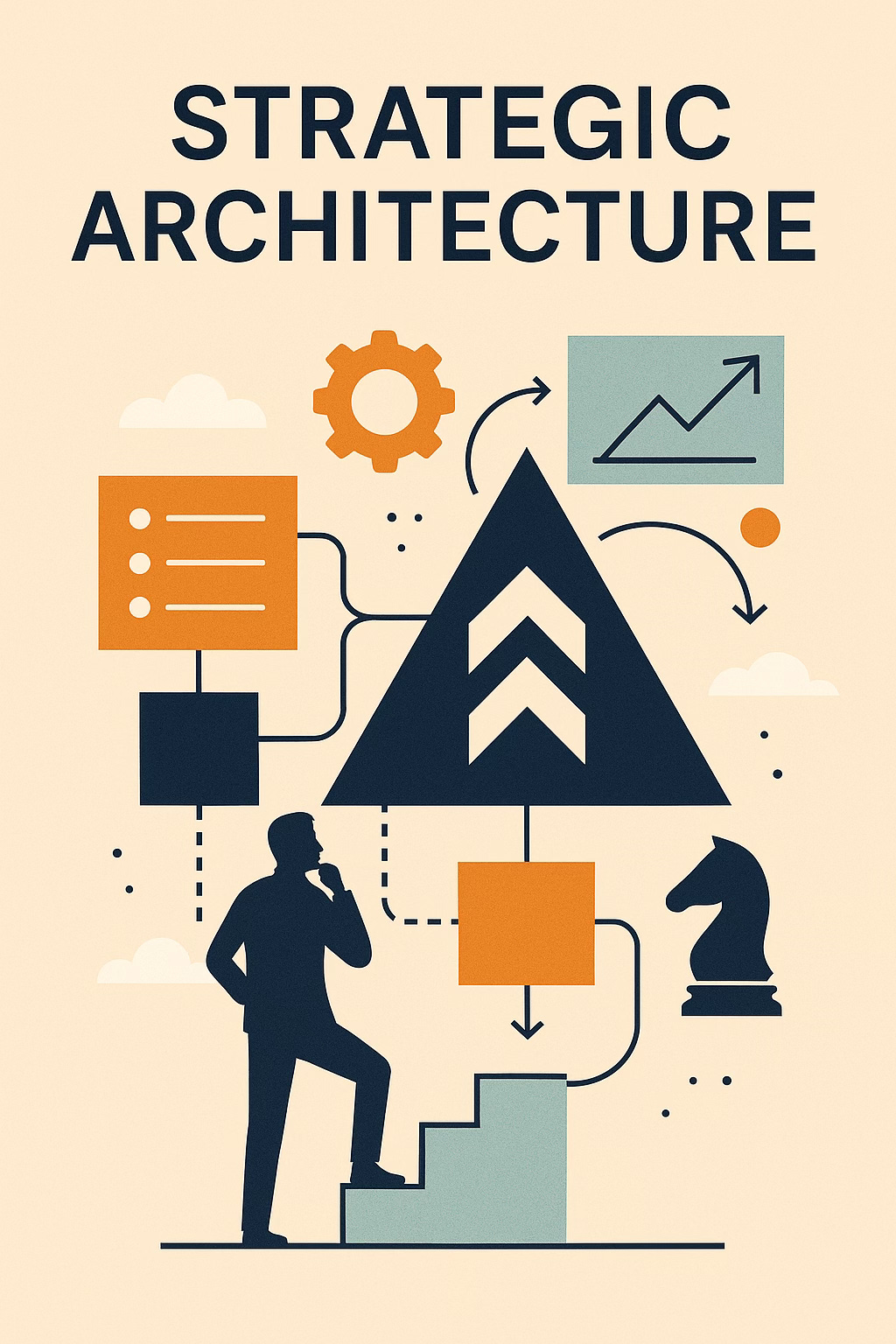
Strategic Architecture is the intentional design of the systems that make strategy executable. It’s not the plan itself, nor is it just enterprise architecture or IT infrastructure. It’s the connective layer between vision and delivery—between ambition and real-world traction.
It includes:
Decision rights – who makes what calls, and on what basis
Value flows – how work, data, and resources move through the organisation
Capability design – how teams are structured and governed
Sequencing – the order and rhythm of change
Strategic Architecture doesn't determine what strategy should be. It ensures the organisation is capable of delivering the strategy it has.
Why Strategy Fails (Even When It's Good)
Many organisations today are undergoing complex transformations—digital, agile, sustainability-focused. They invest in vision, conduct strategy off-sites, launch change programs. But within months, outcomes lag. Teams revert. Momentum fades.
The problem isn’t poor execution—it’s mismatch. The new strategy requires new ways of working, but the old scaffolding remains:
Governance structures that favour the status quo
Metrics that reward continuity over innovation
Architectures that are optimised for efficiency, not adaptability
These mismatches create friction. Strategy stalls not because it lacks support, but because the system hasn’t been re-architected to support it.
Case in Point: The Mid-Viscosity Trap
In my consulting experience, I’ve seen this repeatedly in what I call mid-viscosity organisations. These firms have just enough flexibility to start change, but too much residual structure to complete it.
These organisations:
Launch new initiatives, but within old reporting lines
Assign transformation leaders, but without shifting authority
Set new goals, but keep old incentives
The result? Partial change. Surface transformation. Strategic drift masked by activity.
A Research-Informed View
Emerging research supports what many leaders have felt intuitively. Teece (2007) argues that dynamic capabilities—sensing, seizing, and transforming—are the essence of competitive advantage in turbulent markets. But transformation only happens if the system allows it.
More recently, Mikalef, Pateli, and van de Wetering (2021) found that architecture flexibility and decentralised governance are strong predictors of performance, particularly under conditions of volatility and digital disruption.
What these studies point to is simple but often overlooked: architecture is not neutral. It enables or constrains. It speeds up or slows down. And in strategy, timing is everything.
Four Elements of Strategic Architecture
Strategic Architecture isn’t just an audit—it’s a design task. It requires leaders to rethink how their systems are set up to carry strategy forward.
There are four core elements:
Translational Design
– How strategic intent is embedded into real structures and workflowsStructural Alignment
– Governance, roles, incentives, and decision rights configured to the new directionTemporal Readiness
– Phased change plans aligned with architectural capability to absorb and supportReflexivity
– Continuous learning from execution, with architecture able to adjust
This is not a blueprint you set once a year. It’s a living layer that evolves with the strategy.
Why the CIO Is Now a Strategy Player
One of the most interesting shifts I’ve seen in practice is the emergence of CIOs as strategic enablers. As stewards of enterprise architecture, data infrastructure, and increasingly operating model change, CIOs are uniquely positioned to act as custodians of Strategic Architecture.
But only if they are invited early—before the strategy is finalised. And only if the architecture they manage is allowed to shape, not just respond to, the strategic conversation.
The Strategic Architecture Audit: Questions for Leaders
If you suspect your organisation is struggling with architectural drag, here are five questions to ask:
Are decision rights aligned with the new strategy, or still tied to legacy roles?
Do teams have the structural freedom to act on what the strategy demands?
Are funding, metrics, and governance mechanisms reinforcing the right behaviours?
Has the flow of value through the organisation changed to match the new direction?
Is the enterprise architecture posture aligned with the pace and intent of change?
If the answer to any of these is “no”—the problem may not be execution. It may be architecture.
The Bottom Line
The real risk in strategy isn’t that people resist it.
It’s that the organisation is quietly structured to preserve what it already knows.
Great strategies don’t fail because they lack ambition.
They fail because they lack architectural support.
Strategic Architecture is the missing link—designed not to predict every outcome, but to make the system ready for whatever the strategy demands next.
👋 Keep Exploring
If you’re a leader wrestling with complex transformation, or a strategist looking to build real organisational readiness—not just plans—this is the conversation I write about every week.
📬 Subscribe to StrategyReady to receive practical essays at the intersection of strategy, structure, and execution—based on real advisory work and ongoing doctoral research.
Because the real work of strategy begins after the strategy is written.
And readiness is something we can design.